Bookkeeping automation can save time, improve consistency, and reduce repetitive manual work. However, automation tools are only as effective as the data they receive.
In practice, raw bank transaction exports are often not ready to be used immediately. Descriptions can be inconsistent, merchant names unclear, and categorisation is usually missing. This creates problems for anyone trying to move directly from a raw CSV file into a bookkeeping workflow.
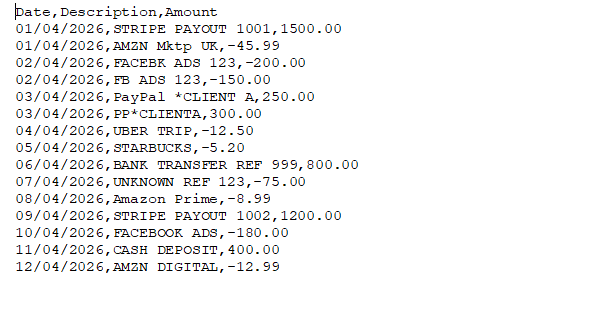
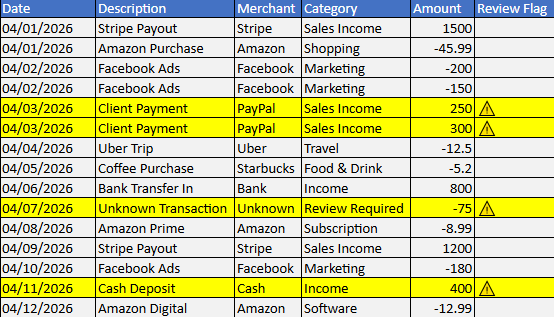
The difference between a raw export and a structured dataset is shown below :
Here is a simple example of a raw bank CSV file before preparation for bookkeeping use.
After preparation, the same data becomes :
The problem with raw bank transaction exports
A typical bank transaction export may be accurate in the sense that it records the money going in and out correctly, but that does not mean it is well-structured for bookkeeping use.
Common issues include:
- Inconsistent transaction descriptions
- Duplicate or unclear merchant names
- Missing transaction categories
- Formatting differences between banks
- Ambiguous entries that require manual review
For example, one transaction may appear as AMZN Mktp UK, another as AMZN DIGITAL, and another as Amazon Prime. A human reviewer can usually see that these are related to Amazon, but an automation tool may treat them as separate and inconsistent entries unless the data is first prepared properly.
Why automation struggles
Automation works best when the input is clean, predictable, and consistent.
If transaction descriptions vary too much, if merchants are unclear, or if categories have not been applied consistently, the result is often:
- Weaker categorisation
- Slower review
- More manual correction
- Less reliable records
This is why bookkeeping automation does not always remove the need for human judgement. In many cases, the first step is not automation — it is preparation.
The role of data preparation
Preparing transaction data before bookkeeping begins helps turn a raw export into a more usable dataset.
This may include:
- Standardising transaction descriptions
- Identifying merchants where possible
- Applying consistent category assignments
- Separating clearer income, expense, or transfer entries
- Flagging transactions that need manual review
The goal is not just to tidy the file, but to make it clearer, more consistent, and more useful within a bookkeeping workflow.
Where this fits in the workflow
A useful way to think about it is:
Raw Bank CSV → Prepared Data → Bookkeeping Workflow
Once the data has been prepared, it becomes much easier to review, categorise, and transfer into a structured transaction log or accounting process.
Why this matters
For accountants, bookkeepers, and small businesses, messy transaction data creates extra work. Automation can help, but only when the starting data is reliable enough to work with.
That is why preparing bank transaction data properly is often one of the most valuable early steps in the process.
If you would like to see how this works in practice, you can view the Data Preparation Guide or get in touch through the Contact page.